


LSU Research Bites: Open-Air Wind Testing Reveals Hidden Risks to Bridges and Buildings
February 24, 2026
Wind breezing or whipping through a bridge or past a building can create vibrations that, over time, can cause severe fatigue damage. This invisible damage can ultimately lead to the structure's failure.
Engineers who work to optimize the designs of bridges and buildings for longevity and safety need ways to test the aerodynamics of their designs.
Traditionally, that’s done in a wind tunnel—the kind you might have seen on car ads or in the F1 movie.
For large structures, such as bridges, scaled-down models can be tested in traditional wind tunnels. The problem is that bridge engineers using this approach often get incomplete or inaccurate results.


Small-scale wind tunnel testing can’t completely simulate the turbulence and peak air pressures of open-air conditions.
Enter LSU’s open-jet testing at the Windstorm Impact, Science, and Engineering (WISE) Laboratory, directed by Aly Mousaad Aly, an associate professor in the Department of Civil and Environmental Engineering, in the College of Engineering.
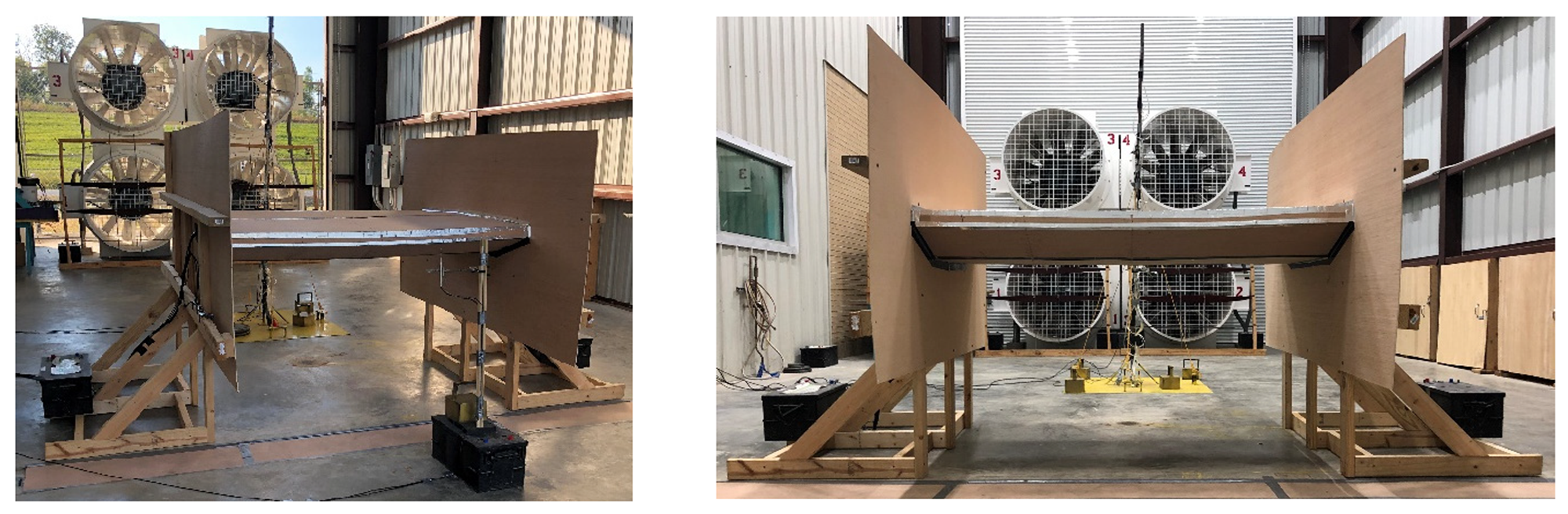
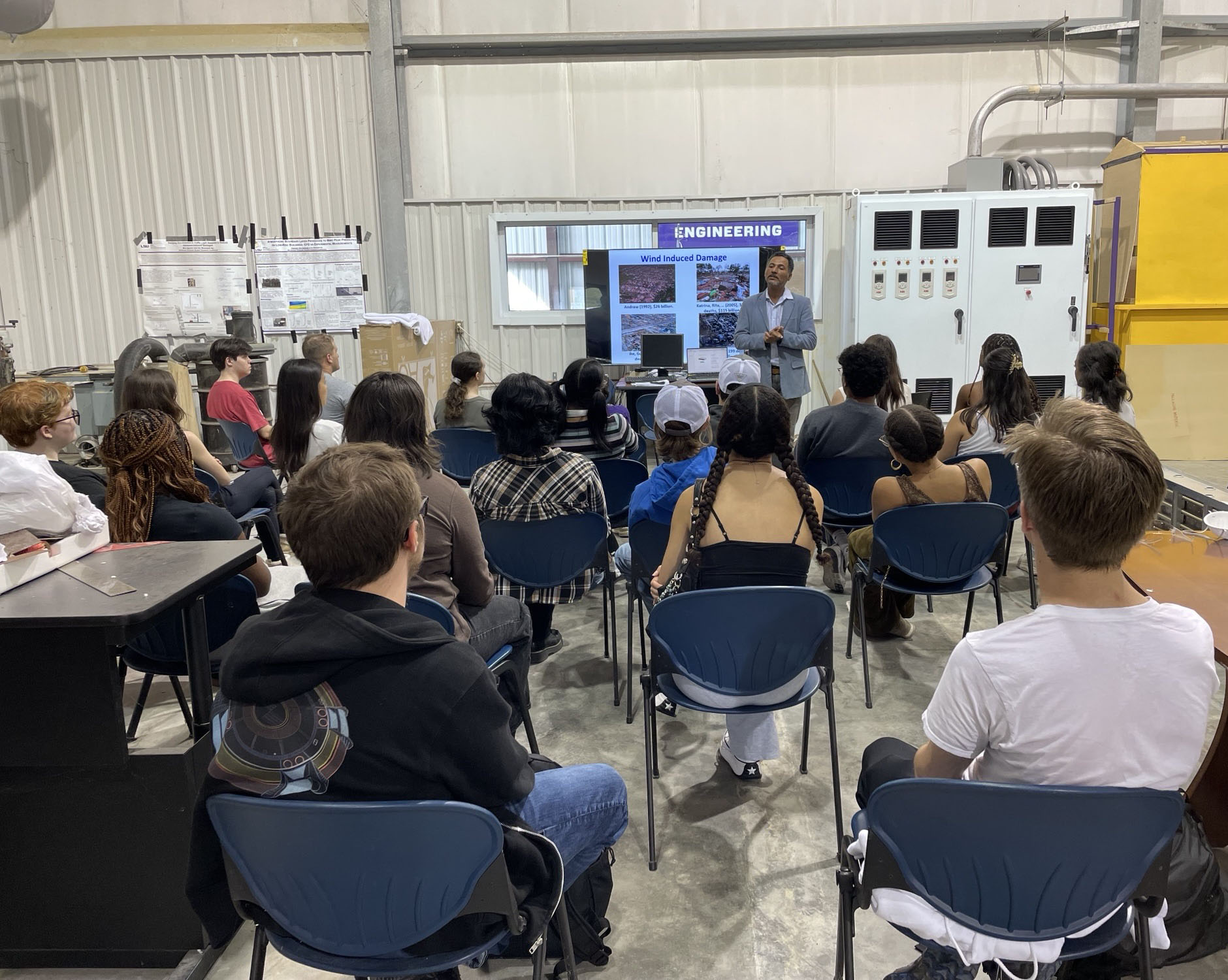
Above: A scaled-down bridge deck model undergoes wind testing inside LSU’s open-jet facility, where researchers measure airflow and pressure to evaluate the structure’s strength and stability under realistic wind conditions. Right: LSU associate professor Aly Mousaad Aly meets with students in the wind-testing lab.
WISE enables testing under more realistic atmospheric conditions, providing scientists with more accurate insights into bridge behavior under dynamic wind loads. In open-jet testing, the wind has no physical boundaries; it can flow more turbulently, following circular and swirling paths.
“This advanced open-jet testing approach represents a significant advancement in wind engineering,” said Aly.
When open-jet testing building structures, the WISE lab found that real peak air pressures were actually 25% to 300% times higher than those obtained from small-scale testing, the norm in the industry. This means that building structures must withstand significantly greater pressures than those traditionally tested.
In other research, the WISE lab has tested the aerodynamics of innovative bridge structures with the open-jet system. They even experimented with placing solar panels in just the right spots to supply energy while redirecting wind to reduce bridge vibrations. Well-placed solar panels reduced wind suction forces on the top of the bridge.
“We show for the first time that strategically integrated solar panels can function as passive aerodynamic mitigation devices on a bridge surface while simultaneously producing renewable energy,” said Aly.
The WISE lab is helping to advance bridge engineering towards more resilient, efficient, and environmentally responsible solutions. The high-quality open-jet data the lab produces also serves as a robust benchmark for future computational simulations.
Read the papers:
- Investigating turbulence and geometric scale effects on surface pressures in the atmospheric boundary layer
- Advancing Bridge Aerodynamics: Open-Jet Testing, Reynolds Number Effects, and Sustainable Mitigation Through Green Energy Integration
Next Step
Discover stories showcasing LSU’s academic excellence, innovation, culture, and impact across Louisiana.